
NHS Trust case study
Mid Yorks deploys AI-powered rostering to cut locum spend by 50% and fulfil 99% of clinician preferences
£25,000
Monthly locum spend reduction for single department (Paediatrics).
99.83%
Of negative shift preferences satisfied.
This is the first time I have been treated like an adult. It is easily the best roster experience I've had in over eight years of training.
Executive summary
As the NHS navigates the mandates of the 10-Point Plan for workforce retention, the transition from fixed-pattern rotas to flexible, clinician-led scheduling has become an operational priority. This report examines the deployment of preference-based rostering (PBR), an AI-powered model built and developed by Patchwork Health.
The context for this report is the Anaesthetics and Paediatrics departments at Mid Yorkshire Teaching NHS Trust (Mid Yorks). Through an iterative implementation model, the programme addressed long-standing issues of locum dependency and trainee attrition. Results indicate a reduction in monthly locum expenditure in Paediatrics from £50,000 to £25,000, alongside meeting 99.83% of clinicians' negative shift preferences.
The findings suggest that the transition to an AI-powered model requires some initial calibration, producing substantial long-term in-system resilience, positive clinician wellbeing, administrative efficiency, detailed visibility of demand versus capacity, and significant cost reduction for temporary staff.
Introduction
The clinical retention crisis
The current NHS workforce crisis is characterised not merely by a deficit of clinicians, but by a crisis of autonomy. National demand for greater clinician agency has highlighted the unsustainability of traditional rostering systems. Fixed patterns, imposed with little regard for personal preference, have historically driven high rates of burnout and an over-reliance on temporary staff and expensive agency locums to fill gaps created by unplanned absences and attrition. While rota coordinators, workforce managers and senior clinicians strive to balance requests for flexibility with service demand, current technologies have created systemic barriers to balancing these necessities.
The algorithm built to solve this problem
Preference-based rostering (PBR) shifts this paradigm. Rather than treating a rota as a static exercise, often carried out on spreadsheets, PBR utilises a sophisticated AI system. Its multi-variable algorithmic model treats workforce deployment as a complex optimisation equation, balancing three competing channels:
- Maintaining safe, mandated staffing levels and skill mixes.
- Adhering to contractual compliance requirements.
- Incorporating individual preferences — positive and negative — to reduce the friction between professional duties and personal lives.
This rostering model was built and developed by Patchwork Health. Patchwork Rota structurally integrates dynamic rostering through two core components: service plans and job plans. Service plans use data-driven modelling to map precise clinical activity — theatres, clinics and ward cover — against baseline patient demand. By linking these operational requirements with clinicians' planned activities, the system enables rotas to be generated that are both service-aligned and compliant with workforce agreements. With clinically validated compliance guardrails embedded throughout, the system is designed to ensure safety standards are consistently upheld, while enabling greater flexibility in how clinicians work.
AI-powered rostering in action
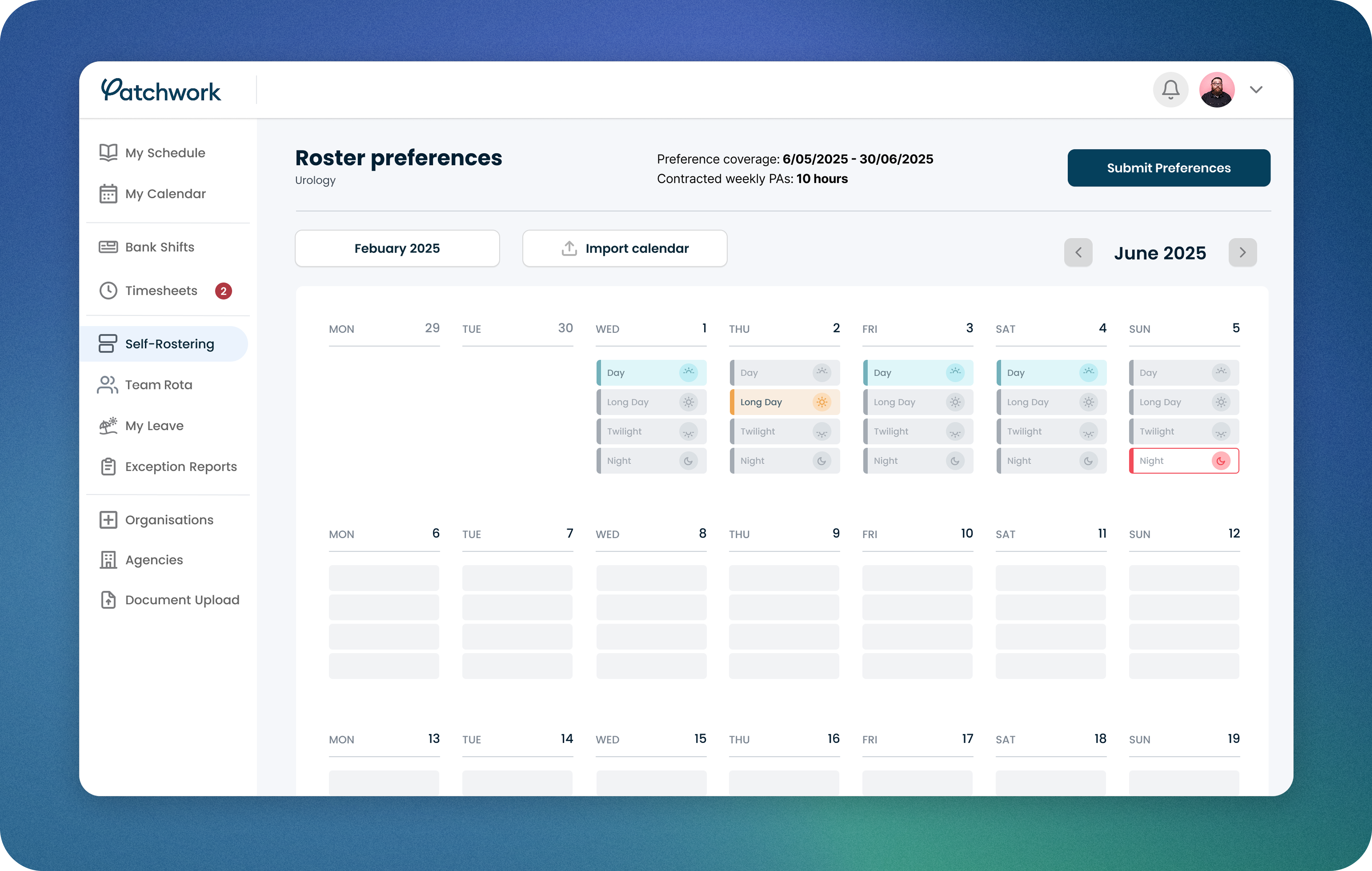
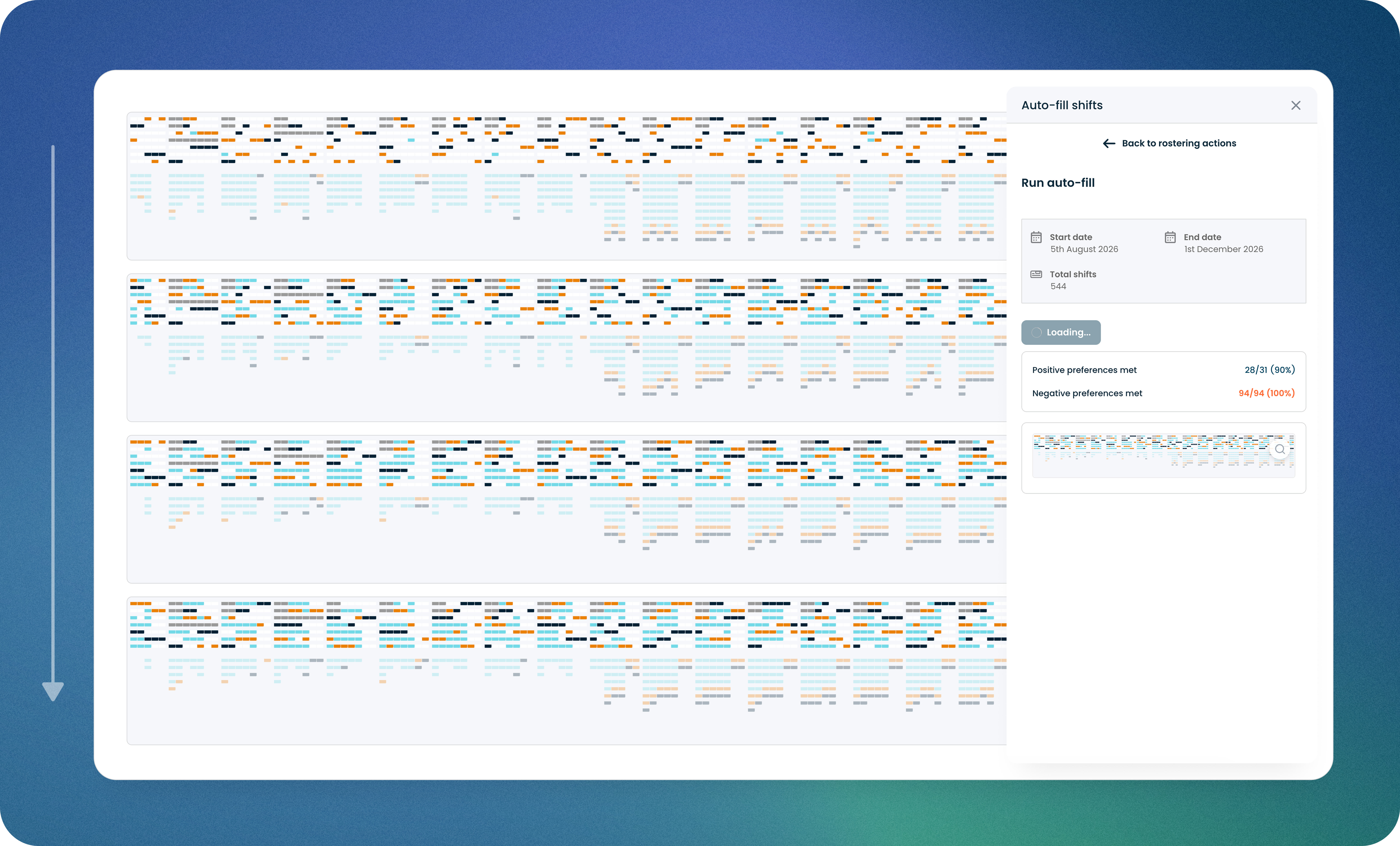
Organisation setting
Local context and operational bottlenecks
Prior to the intervention, Mid Yorkshire Teaching NHS Trust operated on a historic reliance on fixed-pattern rotas within the Anaesthetics and Paediatrics departments. This analogue approach created intense administrative bottlenecks. Medical staffing teams spent disproportionate hours manually reconciling leave and shift-swap requests against rigid rota gaps, creating a highly reactive operational environment.
This friction was particularly obvious when managing Less Than Full Time (LTFT). The operational complexity of bespoke LTFT working patterns into rigid, full-time rota slots frequently resulted in mismatched fractional gaps. When these fragmented schedules could not be manually reconciled without compromising baseline service demand, the remaining shifts were inevitably escalated to the temporary staffing bank, further driving up premium agency spend.
Baseline metrics
This inflexibility carried a high financial and cultural cost. Qualitative baselines indicated that inflexible schedules were having a detrimental impact on wellbeing — a driver for staff seeking roles outside substantive work, or moving to more flexible arrangements elsewhere.
Methodology
Initial discovery work
The intervention was structured not as a standard software rollout, but as an iterative deployment across 26 anaesthetic and 23 paediatric resident doctors. To ensure a robust and well-documented implementation, it was crucial to note the friction points typical of a roll-out of this nature. Two challenges were identified as part of the initial deployment:
Early algorithmic iterations required adjustment to ensure negative preference requests — such as requested time off — were accurately weighted within the scheduling parameters.
Nuanced, local rules regarding 'night-shift intensity' and recovery periods required specific mapping within the core algorithm.
Mid Yorkshire Teaching NHS Trust acted as a strategic co-development partner. The Trust utilised these early operational friction points as vital real-world data, working alongside Patchwork to refine the algorithm. This partnership-driven approach enabled rapid calibration, ensuring the system successfully adapted to the complex realities of the local clinical environment.
Crucially, this iterative refinement was the direct catalyst for the 99.83% negative shift preferences being met and the substantial financial efficiencies realised by the Trust in subsequent rotations. Furthermore, the algorithmic maturity achieved through this collaboration has demonstrated significant system-wide scalability — successive deployments of the updated PBR model across other NHS trusts are underway to replicate these enhanced operational and financial outcomes.
Results
Following the calibration phase, the matured system was evaluated during the December 2025 rotation. The data demonstrates a significant positive shift across both operational and human metrics from challenges previously identified before the partnership began.
99.83%
Of negative shift preferences satisfied. The calibrated algorithm demonstrated a high degree of maturity in managing complex variables, and successfully handled traditionally disruptive mid-rotation training transitions without requiring extensive manual recalculation.
50%
Reduction in monthly locum expenditure within Paediatrics — from £50,000 to £25,000 — a sustained £25,000 monthly efficiency saving from intelligent management of baseline under- and over-establishment.
Qualitative cultural shift
Thematic feedback from the medical workforce indicated a profound cultural shift. The reliable accommodation of major life events — weddings, exams — fundamentally altered the psychological contract between the Trust and its clinicians. These qualitative indicators serve as vital leading metrics for long-term retention, improved job satisfaction and general wellbeing.
Discussion
One critical finding was a slight increase in shift intensity for certain clinicians. To achieve higher levels of individual autonomy, the algorithm occasionally condensed working hours — clustering shifts to reach up to 72 hours over a specific period, compared to a typical 50–54 hour spread. All hours were safely filled by Trust standards. Crucially, this increased utilisation of the substantive workforce directly contributed to the observed reduction in temporary staffing expenditure; by effectively deploying permanent staff, the Trust significantly reduced its reliance on bank and agency cover. This density is a known mathematical variable in achieving high preference satisfaction, and is actively monitored to ensure it stays strictly within safe working limits.
Conclusion
The mandate set out in the NHS 10-Point Plan to deliver flexible working is frequently viewed by acute trusts as an operational impossibility. The deployment at Mid Yorkshire Hospitals NHS Trust demonstrates that compliance is highly feasible when trusts embrace an iterative, partnership-driven approach to workforce technology.
The evidence suggests that Patchwork's preference-based rostering is not merely an administrative upgrading of a spreadsheet. It is a vital strategic lever capable of delivering a dual mandate — ensuring stringent financial sustainability through reduced locum spend, while simultaneously driving the cultural transformation necessary to retain the modern clinical workforce.
AI-powered preference-based rostering
Retention isn't about asking people to cope. It's about designing systems that don't burn them out.
Register your interest in preference-based rostering and our team will walk you through what a deployment looks like inside your trust.